Mercy’s Stream

From my recent book, Soil of the Divine:

I lay my sin-stained soul
before the Lord,
battered and bruised
by my own foolishness
and rebellion.

My sacrifice is not
a lamb without blemish,
but myself
whose stains
are ground in deeply,
yet I keep playing in the mud.

I bring my filth
to the foot of the cross
and my trembling lips whisper
“…mercy.”

My Christ picks me up
and carries me to the river of grace
whose effervescent waters
mingle with my Savior’s blood,
restoring purity
and wholeness.

Tomorrow, I will need
to bathe again
in mercy’s stream.

Purge me with hyssop
and I shall be clean;
wash me,
and I shall be
whiter than snow. -Psalm 51:7

I’ve Got This

Close your eyes. Paint a picture of Jesus in your mind. What does he look like? If eyes reflect the soul, what do you see in his?

Listen to him. How would you describe his voice? Think specifically, what was Jesus’ tone when he said to the woman with the discharge of blood, “daughter, your faith has made you well, go in peace” (Luke 8:48). What did he communicate to the woman caught in adultery when he said “neither do I condemn you” (John 8:11). When I read those words, I hear compassion and mercy.

Consider another story. In the upper room, Peter boldly proclaimed that he would lay down his life for Jesus who responded, “Will you lay down your life for me? Truly, truly I say to you the rooster will not crow until you have denied me three times.” What was Jesus’s tone in this case? As Jesus predicted, Peter denied him. In Luke’s account of the story, we read that after the third denial, “The Lord turned and looked at Peter” (Luke 22:61).

What comes into our minds when we think about God is the most important thing about us.–A.W. Tozer

When Jesus caught Peter’s gaze, what was the look upon his face? For most of my life, when I have heard this story, I have imagined that when Jesus was talking with Peter, an edge of irritation intruded as though Jesus were thinking to himself, “Impetuous Peter. Why did I ever choose him, he’s such a screw up.” Then laying eyes upon him, a look of disgust, eyes that communicated worthlessness.

But a friend challenged me recently. He asked, “What if the look upon Jesus face was not one of disappointment, but communicated, ‘Brother, I’ve got this. You are my beloved. Just wait and see what the Father and I are about to do.’”

Jesus never fails to look upon us with compassion. He never fails to love. Not even once. When we are in Christ, we have no need to think of God as a fickle master, for he is unchanging in his love. He is not a cauldron of boiling wrath waiting to be poured on us when we fail him once more. Every moment of every day he gazes upon us with a look that says, “I’ve got this.”


Shame Clouds

I was clearly busy
with something
“important.”
Dictating an email or text
or perhaps
a Tweet about
the beauty of grace.

Speaking
you interrupted.

Like a fast moving thunderstorm
irritation cast
dark clouds
over my face.

Sounding like distant thunder
I grumbled,
“why do you always
interrupt me
when you can
clearly see
I am talking?”

Meekly, you replied,
“Sorry,”
as your bright smile
was replaced by
a gray haze
pregnant with shame.

It is no wonder
you dislike storms.

Held Tight

From my book, Soil of the Divine:

When trouble to my doorstep comes,
when evil finds a way;
I cry out to the Lord above,
“why are You far away?”

The wicked ones, with evil come,
oppressing the poor and fair;
destruction in their arms and tongues,
saying “God’s not anywhere.”

But You, O Lord, lift up Your hand,
destroy the wicked man;
bring justice to the hurting ones,
as only the Sovereign can.

Your steadfast love and caring arms,
draw in the helpless child;
forgive our sins and hold us tight,
through each and every trial.

O LORD, You hear the desire of the afflicted;
You will strengthen their heart;
You will incline Your ear to do justice
to the fatherless and the oppressed,
so that the man who is of the earth
may strike terror no more.
-Psalm 10:17-1

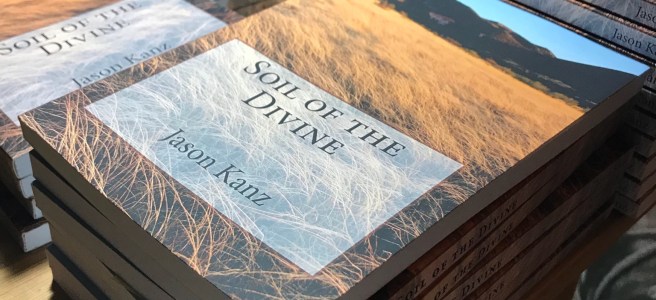
Soil of the Divine

In late 2016, I began working on a book of poetry based upon the Psalms. Each weekday morning, I would read one of the Psalms, meditate upon it, and see what stirred in my heart, with the goal of writing a poem inspired by each Psalm. Some mornings, words flowed easily; on others, I felt blocked, but each day, I wrote. After finishing the draft, I spent a few months editing and tweaking the poems. Some friends graciously agreed to offer editorial assistance as I neared the end (thank you Briana and Cindy!). I formatted the interior, designed the cover, and ultimately sent it on to publication.

Earlier in the week, I received my first case of books. They arrived while I was meeting with 7/8 of my life group. I gathered my children to the basement and subjected them to the grand unveiling. I am grateful they humored me. I sent copies along to a few people, but remained rather tight-lipped. I wanted my mom and my aunt Sandy to see it before I went public with it. They both have their copies, so I am glad to be able to tell you all about it.

IMG_5288.jpg

I do hope you will consider reading Soil of the Divine. Even if poetry “isn’t your thing,” my hope is that you might be edified by it. It’s available on both Kindle and in paperback (if you know me, you are aware of my preference). You can purchase it directly through the CreateSpace e-store or Amazon.

If you are looking for Christmas gifts for everyone you know, I would also be happy to recommend it. 😊

Tin Pail

I submerge the old tin pail
beneath the flowing stream,
I watch the icy water
spilling over the bottom lip
filling the hollow space.

I straighten up
muscles taut
as my fingers curl around
the wire handle.

I carefully carry the pail.
I don’t want to drop its precious contents.
I look to the sun-baked fields.

I see the workers scattered
here and there,
bodies rising from the plain.
They’ve been out in the heat so long
sweat no longer appears at their brow.

I carry the pail for these people,
the parched and dry
who long to be quenched.

Yet some succumb to sun-stroke,
delirious clouds obstructing reason.
I dip the ladle into the silvery liquid
and offer a drink
yet they refuse.
One rasps, “No thanks. I’ll get my own water.”
Another knocks the bucket from my hand,
“What are you trying to do? Poison me?”

I return again to the river.
I rinse off the bucket
fresh dents evident.
I pause
long enough to lower my mouth
to the cool stream,
refreshed.

I dip the bucket again
and once more
carry the bucket to the harvest.