2024 top ten books

It has been interesting to see how my book list has changed over the years. When I first started putting together my book list in 2010, it was essentially all Christian theology books, mostly of the Calvinist persuasion and now none of them fit that category. My top 10 also contains a mix of audiobooks and traditional books, something that would not have happened for me in 2010. I finished 85 books this year so far, which is lower than normal, but there were a number of really good books including some not mentioned on this list. Like last year, I chose not to rank order my list because there was no clear best book.

Star Spangled Jesus: Leaving Christian Nationalism and Finding a True Faith by April Ajoy
Ajoy was all in on Christian nationalism. She campaigned for a Republican presidential candidate, traveled the country with her evangelist father on a bus that said, “America Say Jesus,” and even sang on the Jim Baker show. Eventually, she became concerned about how the faith she claimed often did not seem to be reflected in the Christians she witnessed. In a humorous way, she reflects on her own experiences and the changes in her thinking. Star Spangled Jesus is definitely worth reading if you are a Christian who has heard the term “Christian nationalism,” but have been uncertain what it is about. (audiobook; memoir)

The Kingdom, the Power, and the Glory: American Evangelicals in an Age of Extremism by Tim Alberta
An accomplished journalist, having previously who worked for National Review, Politico, and The Atlantic, Alberta wrote this book out of his own personal experiences with Christian nationalism. Witnessing the toxicity of this movement in the church his father pastored, he set out to explore Christian nationalism in greater depth. From his website, “Evangelical Christians are perhaps the most polarizing—and least understood—people living in America today. In his seminal new book, The Kingdom, the Power, and the Glory, journalist Tim Alberta, himself a practicing Christian and the son of an evangelical pastor, paints an expansive and profoundly troubling portrait of the American evangelical movement. Through the eyes of televangelists and small-town preachers, celebrity revivalists and everyday churchgoers, Alberta tells the story of a faith cheapened by ephemeral fear, a promise corrupted by partisan subterfuge, and a reputation stained by perpetual scandal.” Less humorous and more widely researched, this book would be a great companion to Star Spangled Jesus. (audiobook; nonfiction)

Full Dark, No Stars by Stephen King
I have been a Stephen King fan since I was in high school. I can still remember the first book of his that I read, a fantasy novel co-authored with Peter Straub titled The Talisman. (I actually found a first edition of The Talisman yesterday at a used bookstore). Full Dark, No Stars is everything that makes Stephen King great. It consists of four novellas. Although each of the four stories was excellent, I particularly loved A Good Marriage, where he tells the story of a wife who discovers something terrible. (Hardcover; Horror)

Exvangelicals: Loving, Living, and Leaving the White Evangelical Church by Sarah McCammon
In some regards, Exvangelicals mirrors the books by Ajoy and Alberta mentioned above. Like Alberta, McCammon is a journalist. She currently works as a national correspondent for NPR. Like both Ajoy and Alberta, she grew up as an American evangelical. She writes about how during childhood, her whole existence seemed to be deeply religious including her friends, the books she read, and the movies she watched. As she grew older, however, she began to encounter situations that led to difficult questions about her faith. As was the case for many of us, the attack on the Capitol on January 6 intensified her concerns about sectors of the church in America. It is at the same time more personally reflective than Alberta’s book, but also well researched. (audiobook; memoir)

I’m Glad My Mom Died by Jeanette McCurdy
You may not recognize the name Jeanette McCurdy, but you might remember the show I, Carly where McCurdy played Carly’s sidekick, Sam. With unflinching detail, she describes how her mother got her into show business as a child and kept her there even when she wanted out. She writes about her mother’s controlling, often abusive tendencies and the long-term impact on her mental health. Although funny at points, I would not describe this as a humorous book. It can be difficult to listen to at points, but her story is important nonetheless. (audiobook; memoir)

Know My Name by Chanel Miller
My friend Stephanie recommended this book to me. It tells the story of Chanel Miller, aka Emily Doe, who was sexually assaulted by Brock Turner at Stanford University in 2015. I remember when the story was in the news and the shock when Turner was sentenced to just six months in jail. Miller chose to share her victim impact statement on BuzzFeed and within four days, it had been viewed 11 million times. A very powerful, often difficult account about a victim reckoning with sexual assault. She also narrated her own book and at the end, reads her victim impact statement, her emotion coming through with every word. (audiobook; memoir)

Born a Crime: Stories from a South African Childhood by Trevor Noah
Trevor Noah has been a fixture in American comedy for a number of years with multiple comedy specials and having previously hosted The Daily Show for a number of years. His memoir had been on my shelf for a number of years, but I had not taken the time to read it. I am glad that I finally did. Born a Crime is simultaneously funny and humorous. I also learned a great deal about what it was like for him as a child in post-apartheid South Africa. (hardcover; memoir)

Where the Deer and the Antelope Play: The Pastoral Observations of One Ignorant American Who Loves to Walk Outside by Nick Offerman
Like many people, I knew of Nick Offerman from his portrayal of Ron Swanson on the TV show Parks and Rec as well as his well-deserved Emmy for guest actor in a drama series for his role in the HBO series, The Last of Us. However, he’s also authored four books, including this excellent one. In Where the Deer and the Antelope Play, Offerman writes about conservation and getting outdoors, drawing on his own experiences and reflections. It is funny, wise, and thoughtful. (audiobook, memoir)

Remedy by John Roedel
I first encountered the poetry of John Roedel on Facebook this year. As he wrote about brokenness and healing, he touched my heart in a way that good poets are capable of doing. My immediate impulse was to buy all of his books and read them back-to-back, but I decided to get just one and savor it. I look forward to the rest of them when I get around to them. (paperback; poetry)

Project Hail Mary by Andy Weir
Project Hail Mary is one of those books that seemed to show up every time I would look at my Audible page and apparently for good reason. It was number one on Audible. It was a New York Times bestseller. In 2022, it was audiobook of the year. However, it was when my friend Josh recommended it, I decided to give it a listen and I am so glad that I did. It tells the story of a science teacher who is sent into space on a hopeless mission (thus hail Mary). It is definitely science fiction, but it is equally humorous. Furthermore, it is one of the best audiobook narrations that I have ever heard. (audiobook; science fiction)
Top 10 books-2022

For over a decade, I have put out a list of my favorite books from the year. Nearly every year, I read more than 100 books and it is always a delight to go back and consider what has stirred me most deeply. Reviewing past lists has also been enlightening. It is evident that my reading has diversified over the years. Some may find that concerning; but I believe it has been better for me as a reader and as a person. Scanning this year’s list, storytelling and an appreciation for nature are common themes.

  1. This Here Flesh: Spirituality, Liberation, and the Stories That Make Us by Cole Arthur Riley
    I only had to read the first page of This Here Flesh to know that it would likely make my top ten. To steal a phrase from author Dave Eggers’ memoir, this is truly a “heartbreaking work of staggering genius.” Riley is a compelling storyteller. She invites the reader into her own narrative in a way that moves deeper still, to lead us into the depth and beauty of our own stories. A friend had recommended the book to me and I have recommended it to others and their responses have been similar. This Here Flesh is absolutely a must read book.
  2. This Is Happiness by Niall Williams
    Earlier in the year, I was looking for fun audiobook titles and Steve Wiens recommended This is Happiness. I had never heard of the book, nor the author. Williams is also a wonderful storyteller. In this novel, he envisions electricity coming to a sleepy Irish town that has not dealt with much change over the generations. It is a welcome touch of humanity and a reminder of what connects us all.
  3. Call Us What We Carry: Poems by Amanda Gorman
    Poetry is hard for a lot of people, but 24 year old Gorman–the first national youth poet Laureate and the youngest inaugural poet–makes it easier. Her ability to draw pictures with her words and to move her readers is breathtaking. If you have been reluctant to dive into poetry, her words and wisdom may be a great entry point.
  4. Everything Sad is Untrue: (a true story) by Daniel Nayeri
    In my circles this year, it seemed as though Everything Sad is Untrue was getting a lot of buzz, but I wasn’t sure if it was fiction, non-fiction, or something else. I’m still not sure, and I think that is Nayeri’s brilliance. Daniel Nayeri was born in Iran and emigrated to Oklahoma when he was 8 years old with his mother and sister, after spending some time as a refugee, which are stories he shares in his book. The book is clearly based upon the details of his life, but reveals him to be an imaginative storyteller (can you sense a theme?). Regardless of what details are factual verses embellished, Everything Sad is Untrue touches something deeply true and human.
  5. Where the Light Fell: A Memoir by Phillip Yancey
    I have read several of Yancey’s books over the years, but this is a new favorite. It is, as the subtitle suggests, a memoir–a spiritual memoir of sorts. Yancey said of the book, “I truly believe this is the one book I was put on earth to write. So many of the strands from my childhood—racial hostility, political division, culture wars—have resurfaced in modern form. Looking back points me forward” Yancey is not shy about naming the origin of some of his own unhealthy beliefs and how he has reckoned with those in his adult years, and continues to do so now in his seventh decade. He has something to teach all of us.
  6. 12 Steps to a Compassionate Life by Karen Amrstong
    Karen Armstrong has published a couple dozen books in her writing career that has spanned more than 40 years, but I am a belated fan. I read her 2022 release, Sacred Nature: Restoring Our Ancient Bond With the Natural World this fall and immediately wondered what else I had been missing, so I moved on to 12 Steps to a Compassionate Life and I loved it too. This former nun and religious historian explores themes common to various faith traditions to demonstrate our unified need for compassion. She wrote about concepts such as concern for everybody and love for enemies and how we might employ these in our day to day lives.
  7. Braiding Sweetgrass: Indigenous Wisdom, Scientific Knowledge, and the Teaching of Plants by Robin Wall Kimmerer
    Braiding Sweetgrass had been lurking around my wish list for a long time and I finally decided to check it out. I wasn’t disappointed. Dr. Kimmerer is a botanist and Potawatomi woman who writes beautifully about our connection with plants and the land on which they grow. Much like most of the authors on this list, she is an excellent storyteller and teacher. Books like this one make me want to care for the earth, and specifically where I have found a home, more deeply and thoughtfully.
  8. God of the Garden: Thoughts on Creation, Culture, and the Kingdom by Andrew Peterson
    If Andrew Peterson publishes a new book, there is a good chance it will be on my top ten list. In God of the Garden, he explores our connection with plants, and especially with trees and what they say about our relationship to God. Too often as Christians, we can distort what it means to steward the earth and we end up abusing our God-given role. Peterson invites us back to a gentler, humbler, more thoughtful place of creation care.
  9. All About Love: New Visions by bell hooks
    bell hooks died one year ago today (12-15-21). She was a social activist, author, and professor who wrote nearly 40 books, often exploring issues of race, gender, and economics, but in All About Love, she explores how to understand love as people who grow up embedded in families, cultures, and systems. Along the way, she shares much of her own story and how she has come to understand love. I remain awed by her bravery and honesty as she wrote unapologetically about many of the difficult things she had experienced growing up and how they have shaped her.
  10. Wild Land Within: Cultivating Wholeness Through Spiritual Practice by Lisa Colon Delay
    Sometimes I pick a book up and it isn’t the right time for me, but when I return to it, it touches me deeply. Wild Land Within did that for me. When I first purchased it, I started reading and realized I wasn’t in the right heart-space to learn what I needed to from the author. I am so glad I returned. Delay draws together threads from neuroscience, theology, and spiritual formation to help her readers “cultivate wholeness.” Perhaps my favorite part of this book was the way in which she drew upon the spiritual practices of various racial and ethnic traditions to weave together this excellent book.

hemispheric processing and western thought

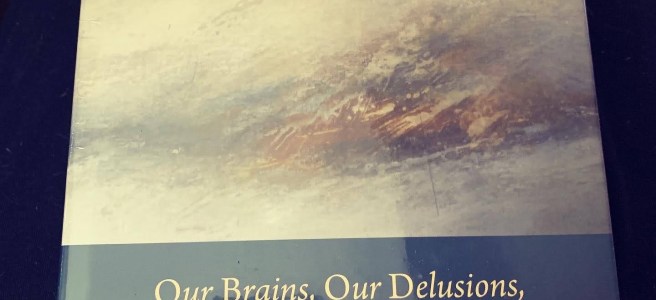
I am about 50 pages into McGilchrist’s latest book, The Matter With Things: Our Brains, Our Delusions, and the Unmaking of the World. He is expanding upon the hemispheric thinking he so eloquently described in his book The Master and His Emissary.* Much of our modern thought is dominated by left mode** processing, which is thought to be logical, linear, and reasonable, but it is poor at appreciating the big picture.

McGilchrist writes, “The left hemisphere is aware of much less of what surrounds it–‘sees less,’ in all senses, than the right. It is less tolerant of ambiguity and tends towards exclusive ‘either/or’ thinking; the right hemisphere is more inclusive, inclined to ‘both/and’ thinking” (p. 44).

The implications for this thinking seem relatively obvious in much of western thought and, by extension, western (primarily evangelical) theology. As good as the left hemisphere is at analyzing details, it is exquisitely unaware of what it does NOT know, which is problematic. The same is true of much of intellectual and theological certainty.

*Most of the pop-psychological literature and thinking about hemispheric (left brain/right brain) differences is, frankly, BS. However, McGilchrist is no pop psychologist and has spent a lifetime exploring the science behind hemispheric asymmetry and the implications.

**I prefer the term “left-mode” to “left-hemisphere” because it seems to me that it is the processes, rather than the anatomy, that matter.

2021 top 10 books

The annual tradition of posting my top 10 book list continues. As of today, December 17th, I have read 93 books, so I will certainly finish the year under 100. As usual, the majority of the books I read dealt broadly with the topic of spirituality. I read disappointingly few fiction books this year. Apart from favorites that I read every year (i.e., the Harry Potter Series, the Wingfeather Saga, and The Great Divorce), I only read two fiction books–The Idiot by Fyodor Dostoyevsky and Dear Evan Hansen. I also read Letters to the Beloved, the book I published earlier this year, no less than four times, but I probably should not include that book in my top 10 list; however, feel free to include it in yours.

Shalom and the Community of Creation: An Indigenous Vision by Randy Woodley
Woodley’s book was a welcome addition to my library in my ongoing study of wholeness and shalom. He explores the similarities between the biblical concept of shalom and the Native American “Harmony Way.” I have so much to learn from those outside of my limited background and this “indigenous vision” is a beneficial invitation.

Grounded: Finding God in the World. A Spiritual Revolution by Diana Butler Bass
In Grounded, Diana Butler Bass provides a well-integrated understanding of science and faith to explore why many people leave traditional religious beliefs and practices. Using metaphors like soil, water, and ground, she weaves a compelling tale of faith.

Leaving Church: A Memoir of Faith by Barbara Brown Taylor
One of the common themes you will discover in this list is how much I enjoy “memoirs of faith,” stories about how people come to understand God and themselves better. In Leaving Church, the author described her journey into the priesthood, pastoring in the church, and her journey away from it into a more expansive faith. She has proven to be a great storyteller in each of her books, and Leaving Church is no different.

Rage by Bob Woodward
Although I primarily read books about spirituality, I also have an unhealthy compulsion to read books about politics. Woodward is a Pulitzer Prize-winning author who has written best-selling books on the last nine presidents. Rage is Woodward’s second book about President Trump and deals with his relationships with key staff members and world leaders and his unconventional ways of leading a nation.

No Cure for Being Human: And Other Truths I Need to Hear by Kate Bowler
Bowler is a witty professor of Christian history at Duke University. In No Cure for Being Human, she tells the story of being diagnosed with stage IV colon cancer at age 35 and reckoning with life and mortality as a wife, mother, and female professor. However, her book is, not surprisingly, about being human. It is a readable memoir that will stir you.

After Evangelicalism: The Path to a New Christianity by David Gushee
After Evangelicalism was the first of three books by David Gushee that I read this year. One of the foremost Christian ethicists globally, Gushee has been a reasoned voice for sincere Christian faith in a post-evangelical world. I have been uncomfortable with the label “ex-vangelical” and “post-evangelical” more accurately captured my self-understanding.

Wholehearted Faith by Rachel Held Evans
In 2019, Rachel Held Evans died following an allergic reaction to a medication for an infection. She was 37 years old. The author of four books before she died, she was a robust online presence and capable communicator. Before her untimely death, she began Wholehearted Faith, and her friend Jeff Chu finished it. It is a beautiful exploration of spirituality and wholeness. Before this year, I had never read any of her books, but the two I have read are on my top 10 list this year. I guess I will need to find the other four.

What God is Like by Rachel Held Evans and Matthew Paul Turner
The second posthumous book on my top 10 list by Rachel Held Evans is the first children’s book I have ever included in my top 10. It is a wonderful, delightful, beautiful invitation into the presence of a gracious and welcoming God. *By the way, it is not only for kids.

Faith After Doubt: Why Your Faith Stopped Working and What to Do About It by Brian McLaren.
McLaren is one of those authors Christians warned me about. For many years, I understood that McLaren and those like him represented “liberal Christianity,” which I further came to believe was not “real” Christianity. However, in Faith After Doubt, I found a spark of hope that I haven’t had for a while in the writings of a person who shows a deep understanding of the spiritual journey and a willingness to say provocative things to encourage his readers toward growth.

In the Shelter: Finding a Home in the World by Padraig O Tuama.
Hands down, In the Shelter by Padraig O Tuama was my favorite book this year. O Tuama is an Irish poet and theologian. He also advocates for peace and inner work, which clearly and beautifully comes across in this stunning work. Pieces that give me a glimpse into the inner work of the writer are profoundly inviting. O Tuama discusses his journey and his relationship with God and himself.

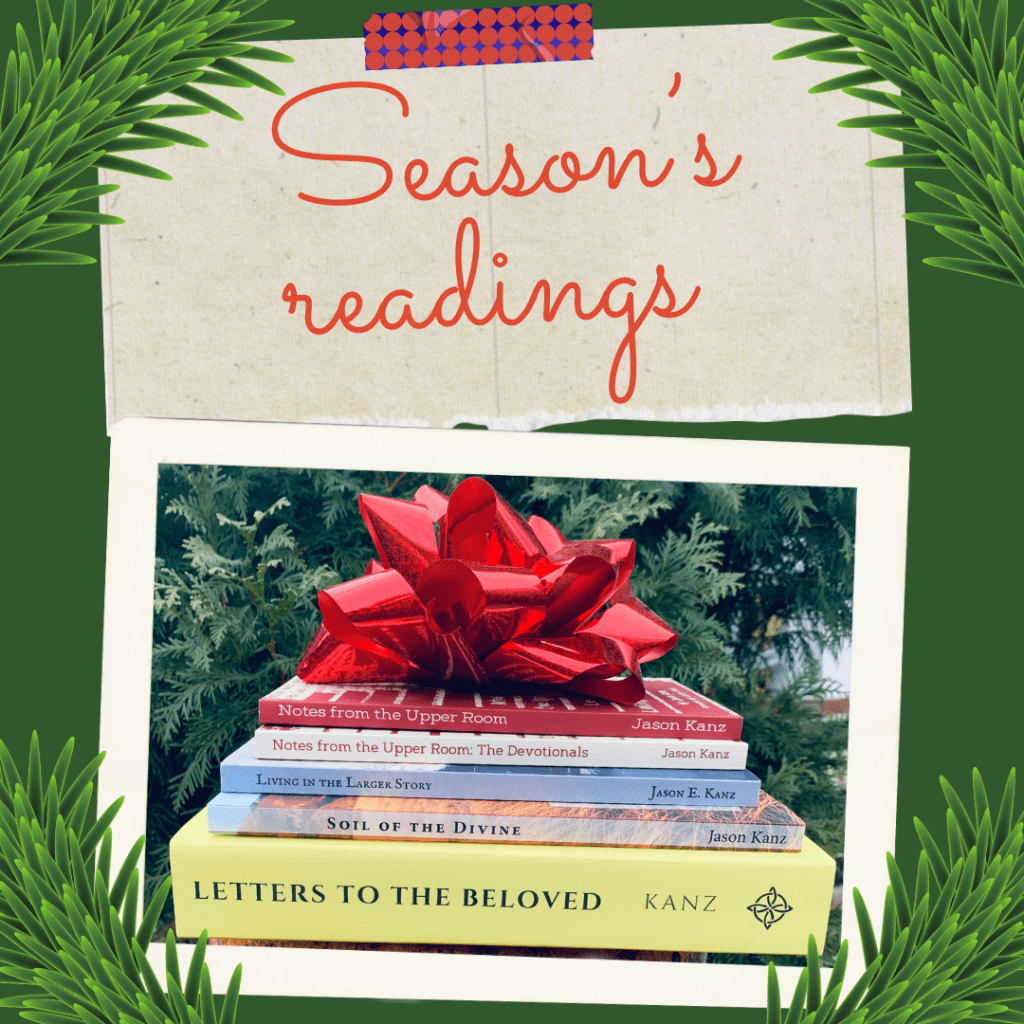
season’s readings

My youngest daughter reminded me that Christmas is exactly one month away, which means you still have time to order copies of my books for yourself or your loved ones. In fact, why not both?

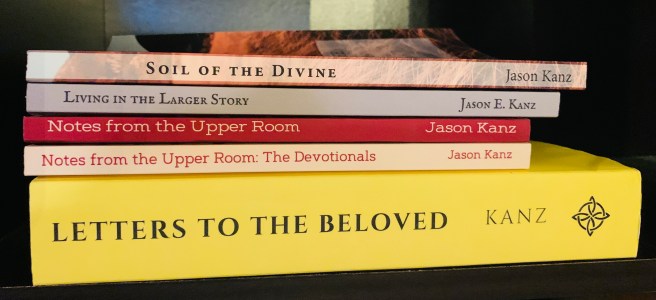
I published my first book, Soil of the Divine, in 2017. It is a collection of 150 poems and prayers based upon the psalms. (Paperback = $8.99; Kindle = $3.99).

My second book, Living in the Larger Story: The Christian Psychology of Larry Crabb, came out in 2019. I was the editor of this wonderful volume published by the Gideon Institute for Christian Psychology and Counseling. In addition to the chapter I wrote with Bryan Maier, there are excellent chapters from experts in Christian Psychology. (Paperback = $12.95; Kindle = $9.49).

Books three and four came out together in 2020. Notes from the Upper Room: Lessons in Loving Like Jesus, and an available devotional filled with unique content, focused on Jesus’s last meal with his disciples discussed in John 13 to 17, which is often known as the Upper Room discourse. (Book: Paperback = $9.99; Kindle = $7.99 / Devotional: Paperback = $5.56; Kindle = $0.99).

One month ago, I released my most ambitious writing project, Letters to the Beloved, which I worked on for six years. In this devotional commentary, I wrote through the New Testament verse by verse as though God was telling me about it in letter form. (Paperback = $24.95; Kindle = $9.99).

Each of the books is available on Amazon in both paperback and Kindle formats. However, a limited number of sets are also available directly from me, though I will order more if I run out.

Altogether, the five books are nearly $65.00 on Amazon, though if you order all five from me, I will sell them for $50.00 plus shipping and handling. If you are interested in some other combination of titles, reach out, and we’ll see what we can figure out.

Season’s Readings!

Top 10 books–2020

I have put together a top 10 books list every year for over a decade. Although I have read fewer books this year than any since I began consistently keeping track in 2014, I had no trouble finding ten eleven books to recommend. You should also have plenty of time to order some of these for jolabokaflod.

Honorable Mention: God and the Pandemic: A Christian Reflection on the Coronavirus and its Aftermath (2020) by N.T. Wright. God and the Pandemic receives an honorable mention because it is particularly relevant in 2020, but hopefully its relevance will soon diminish. Regardless, Wright, addressed many of the concerns raised by Christians about how to live in this time, finding a reasonable way between the extremes of denial and obsession. He helps us, as readers, to think about what it means to be Christians in the world today.

10. Christ of the Celts: The Healing of Creation (2008) by John Philip Newell. I read several books about Celtic spirituality this year, including three from John Philip Newell. Newell writes like a poet, which is part of my draw to him, I suppose. My attraction to Celtic spirituality is related to its connection with how I see and understand the world, with attention to things like creation, wholeness, interconnectedness, and creativity.

9. Ready Player One (2011) by Ernest Cline. When the Ready Player One movie came out in 2018, I saw it in the theater and I loved it, perhaps because I am a child of the eighties. I often return to the movie when I am looking for entertainment. Although Cline’s book has the same basic premise, there is a much greater richness and depth to the storytelling. I began with the audiobook, which is narrated by Wil Wheaton, who played Wesley Crusher on Star Trek: The Next Generation, but because I am impatient and could not wait for my son to finish the audiobook with me, I purchased the paperback and quickly finished it. You cannot go wrong with either.

8. Something’s Not Right: Decoding the Hidden Tactics of Abuse–and Freeing Yourself from its Power (2020) by Wade Mullen. In the past few years, I have read several books about spiritual abuse and Something’s Not Right is among the best of them. Mullen writes from years of experience and research, yet does so in an accessible way. I particularly appreciated his discussion of how abusive organizations often use “impression management.” If you want to learn more about systemic abuse, I could not point you in a better direction than Something’s Not Right.

7. What Unites Us: Reflections on Patriotism (2017) by Dan Rather and Elliot Kirschner. The past four years in America have felt increasingly divisive. Deception and vitriol ravage political decency and we have lost sight of what has made America great. Dan Rather, together with his colleague, Elliot Kirschner, put together 15 essays about America that filled me with hope. Drawing from his nearly nine decades as an American citizen, Rather addressed topics such as voting, the press, science, the arts, and the environment. As I listened, I wondered how I can foster the sort of vision Rather and Kirschner have of and for America.

6. 11/22/63 (2011) by Stephen King. There was a time in my life when I read books by Stephen King, and little else. In high school, I wrote a paper about him and I remember going to the Mead Public Library in Sheboygan, Wisconsin to ask the librarian to obtain a copy of the Playboy magazine interview with him for my paper. My friend Jordan turned me on to 11/22/63, which he described as one of his favorite books. I listened to the audiobook, which was narrated by Craig Wasson, and I was captivated once again by King’s ability to craft a story.

5. Jesus and John Wayne: How White Evangelicals Corrupted a Faith and Fractured a Nation (2020) by Kristin Kobes DuMez. Jesus and John Wayne may be the most provocative title on my top 10 list. When I posted a picture of the book cover on my Facebook page and expressed my eagerness to read it, a family member commented, “Give me a break!” I suspect the author has heard far worse. Briefly, the author traced the often parallel paths of rugged masculinity and 20th century evangelicalism, identifying the fallout. If you been trying to make sense of evangelicalism in post-Trump America, you cannot do much better than Jesus and John Wayne.

4. Exclusion and Embrace, Revised and Updated: A Theological Exploration of Identity, Otherness, and Reconciliation (2019 revision) by Miroslav Volf. My friend Perry, who often has great book recommendations, suggested Exclusion and Embrace and I was not disappointed. Volf is an accomplished theologian, but more importantly, he was raised in Croatia and a witness to ethnic cleansing in the former Yugoslavia. He has an exceptional understanding of confronting oppression, neither dismissing hurt nor the hard work of reconciliation. My copy is filled with underlines and marginalia, which is typically a sign of a book that engaged me deeply.

3. Art + Faith: A Theology of Making (2020) by Makoto Fujimura. I think a lot about topics like goodness, truth, and beauty and their connection to becoming whole. In his previous book, Culture Care, Fujimura introduced me to the term “maercstapa,” which is a border stalker. Maercstapas explore what is possible and bring it back to people. I was equally pleased with Art + Faith, which is just a few weeks old. Fujimura built upon ideas introduced in his former books in developing a thoughtful “theology of making” as he described it. I especially appreciated his connection between the work of creativity and God’s new creation. Weaving in examples from several of my favorite artists and writers solidified its position on the top 10 list.

2. Adorning the Dark: Thoughts on Community, Calling, and the Mystery of Making (2019) by Andrew Peterson. I read Adorning the Dark in January and knew that it was going to be a good book year. It is no surprise to anyone who knows me that Andrew Peterson is my favorite singer. He also wrote one of my favorite book series, the four volume Wingfeather Saga. Over the years, I have appreciated his thoughts on beauty and the creative process, so I welcomed having his thoughts condensed in book form. Like Art + Faith, Peterson’s book stirs my love for wholeness and beauty.

1. An Interrupted Life: The Diaries, 1941-1943; and Letters from Westerbork (1981) by Etty Hillesum. As soon as I began reading this book, I knew it would be on my “must read” list, not to mention my 2020 Top 10. I first heard about Etty Hillesum from the writings of Chuck DeGroat, the author of Wholeheartedness, which is another favorite book of mine. Etty Hillesum was a Dutch Jewish woman living in the Netherlands at the beginning of World War II. She kept a series of self-reflective journals from 1941 until 1943, when she was sent to Auschwitz. She demonstrates an uncommon spiritual depth, no doubt sharpened by her experiences.

Notes from the Upper Room

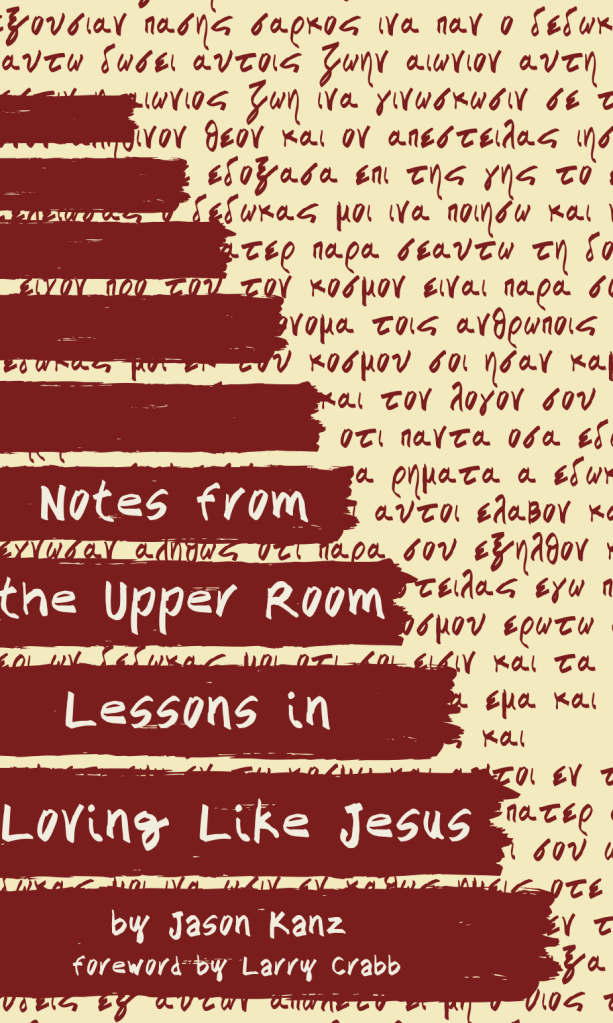
I am very happy to announce that my most recent book, Notes from the Upper Room: Lessons in Loving Like Jesus, is available through Amazon in either paperback or e-book.

From the Back Cover:
John 13 to 17, often referred to as the “Upper Room Discourse,” provides John’s narrative of the disciples’ last meal with Jesus. There is no place in the Bible where a single conversation is so carefully recounted, making up nearly one-fifth of John’s Gospel. In Notes from the Upper Room: Lesson in Loving Like Jesus, you are invited to listen in on their conversation, and learn what it means to love like Jesus. From the very first verse of John 13 and the very last verse of John 17, love was the recurrent them. Jesus showed love for his disciples by washing their feet. He taught them about what real love looked like and how he wanted them to put love into practice. In his longest recorded prayer, John 17, he prayed that they would love one another in the same way that the he and the Father loved one another. We were created for relationship, with God and one another. In Notes from the Upper Room, you will learn about loving and relating in the manner of Jesus. Climb the steps, take a look around, and have a seat.

“Jason’s gracious and wise perspective on the Upper Room discourse strikes at the heart of the Gospel, with a hard-to-find balance of depth and accessibility. He applies the love of Jesus to the tensions of our brokenness with great care and empathy. This is an extremely encouraging and uplifting book, and one that I highly recommend you read.”-Chris Wheeler, author of Solace

“If you’re hungry for a biblically centered understanding of both the difficulties and the possibilities of actually putting the love of Jesus on display by how you relate to your spouse, children, friends, and co-workers, Notes from the Upper Room sets the table with a tasty meal. In a strong, clear, and gentle voice, Jason speaks to the crucial value of Trinitarian theology for living the relationally loving life we were designed and equipped to live. This a book well worth reading.”—Larry Crabb, Psychologist and author of When God’s Ways Make No Sense

Here are several ways you could support this project:
1) Please consider purchasing a copy either through Amazon or directly from me and reading it. Books also make great gifts.
2) If you found the book beneficial, would you consider leaving a review on Amazon and, if you use it, Goodreads? Reviews are very helpful to authors.
3) Consider following my blog through WordPress or subscribing by email.
4) If you email me at jasonkanz (at) yahoo (dot) com, I will send you a free PDF of 129 devotionals I wrote based upon John 13 to 17 as well. If the Lessons in Loving Like Jesus is a finely cooked steak, the devotionals are steak bites–the same meat, prepared differently. The devotionals will also be available in a paperback version through Amazon.
5) Stay in touch. Let me know what stirs for you as you read the book.

Go out and love like Jesus.

Living in the Larger Story

This book, Living in the Larger Story: The Christian Psychology of Larry Crabb, has been a long time in coming. In 2015, Eric Johnson passed along a few pages that Bryan Maier had written about Larry Crabb for the Christian Psychology journal, Edification and with Bryan’s blessing, asked me to revise and extend it for a possible journal article.

I dug into Larry’s writings—at the time, 24 books—trying to identify the themes and development of his thinking as a Christian psychologist over a career spanning over 40 years. Larry graciously offered me a lot of background and information as well. Eventually, I finished the article and asked authors from multiple fields to respond to what Bryan and I had written. Nearly everyone I asked agreed to contribute, grateful for Larry’s influence in their lives. After compiling the responses, Larry wrote a final piece, integrating the responses with his own reflections on his career.

Still, the plan was to publish these articles together in a special issue, but due to a variety of circumstances, that option became untenable. In preparation for a conference celebrating Larry’s career and the founding of the Gideon Institute for Christian Psychology and Counseling at Houston Baptist University in May 2019, we chose to put it together as a limited run book for the conference attendees. However, there was enough interest in the book that I had hoped to release the book more widely for those who were unable to attend the conference but who love Larry as much as I do.

As of yesterday, Living in the Larger Story is finally available through Amazon (It should be available through other distributors soon). It is available in paperback and as a Kindle book. The formatting of the e-book is slightly different, though the content is the same.

As the editor of Living in the Larger Story, I decided to split any proceeds from the book between Larry’s non-profit NewWay Ministries and the Gideon Institute. If you purchase one book or 100, not only will you get what I think is an important and interesting book, but you will benefit two very important ministries. I do hope you will consider supporting the book and these two ministries through your purchase.

Top 10 books–2019

For the past decade, I have posted my favorite ten books I read during the previous year. 2019 has been a light reading year for me; so far, I have finished 81 books, which is about two dozen fewer than my average, which also means that the field of contenders is smaller. As I consider this year’s list and I compare it with previous lists, I am aware of a shift in my thinking. Of course, the question arises, has my thinking shifted because of what I am reading, or do I choose books that reflect these changes? Presumably a bit of both. Another observation and a warning to go with it: at least seven of these books may challenge deeply held assumptions. So, without further adieu, here are 2019’s top ten.