It’s getting so close. Only two tabs missing—Acts and 2 Timothy, which will probably take a couple of months. And then editing. #amwriting #bible #relationaltheology


It’s getting so close. Only two tabs missing—Acts and 2 Timothy, which will probably take a couple of months. And then editing. #amwriting #bible #relationaltheology

Our country is in the midst of a pandemic, a plague that is crippling both citizens and society. I am not talking about COVID-19. The virus that I am thinking of has a much wider reach, but it is not our bodies that are getting sick, but our souls.
In light of COVID-19, our world has drastically changed. Nearly everything that we do has been touched by the virus–our economy, our social lives, our religious observances, our mental health. As the weeks pass, our fragmentation becomes more obvious. As stresses build, those dark parts of us rise to the surface and they play out not only in our homes, but across social media which, it seems, is now our principle form of connection.
This pandemic of divisiveness and hatred dwarfs COVID-19 in both its effects and its reach. Although many of us may not get COVID-19, if my Facebook and Twitter feeds are any indication, many of us have been showing symptoms of hatred and division, more and more each day. Unfortunately, we are a whole lot better at seeing these things in others than in ourselves. We are much more capable of justifying our anger and name calling in the name of justice. When we have no doubt that we are correct, everything is permitted.
Just in the last few days, I’ve seen people I love calling Governor Evers an idiot or, alternatively, President Trump. I wish I were immune. I’ve seen boatloads of misinformation disseminated, but we believe these “facts” because they come from “our side’s” media outlets and experts. We use this misinformation to justify our righteous indignation. Suddenly, it seems that all of us are experts in virology, epidemiology, economics, and constitutional law.
Friends, this hatred, animosity, and division is killing us. Anger can make us feel alive, but too often it is stoked by toxicity. Many of us are thoughtful about the food we consume, trying to keep our bodies healthy, but we allow these viral thoughts to take hold and our souls get sicker and sicker. I pray we begin to wake up to the effects this soul pandemic is having.
I’ve been thinking a lot about Galatians 5 recently, which is one place where Saint Paul contrasts flesh and spirit. In each of us, there is this battle between flesh and spirit and they do not lead us to the same outcome. Starting in verse 19, Paul identified a number of “works of the flesh,” which are opposed to a Spirit-filled life. I won’t mention all of them, but I was struck by “enmity, strife, fits of anger, rivalries, dissensions, and divisions.” Sadly, this list seems to characterize so much of what I read every single day. Paul is clear that these things do not represent the Kingdom of God. But he also said that when we are walking by the Spirit, there are different evidences in our lives. A Spirit-led person shows love, joy, peace, patience, kindness, goodness, faithfulness, gentleness, and self-control, not perfectly, but I believe in increasing measure.
I invite each of us, myself chiefly, to regularly ask ourselves, “Who am I? Are my thoughts and actions characterized by fits of anger and division, or am I increasingly gentle and peaceful?” This soul pandemic has a cure, love.
God,
The evidences of fragmentation and division are growing day by day,
both without and within.
You call us to peace, but we are in turmoil;
you call us to grace, but we are full of judgment;
you call us to love, but hatred consumes us.
We are a double-minded people.
How can we be for peace when this war rages within?
We do spiritual violence to others and ourselves
when this plague of strife takes hold.
We are afraid.
We are angry.
We are confused.
Too often, we let our flesh lead,
forgetting both who you are
and who we are.
Forgive us.
Heal our hearts.
Make us whole.

But the fruit of the Spirit is love, joy, peace, patience, kindness, goodness, faithfulness, gentleness, and self-control–Galatians 5:22-23
Lately, I have been thinking about Paul’s last descriptor of the fruit of the Holy Spirit in our lives, self-control. I don’t really like that one. Maybe it is because it sometimes seems out of place with regard to the rest of the descriptors. More than likely, however, it is the character trait that seems most underdeveloped in my life. Perhaps those who know me well would suggest that all of them are equally underdeveloped. Part of the reason I don’t like the notion of self-control, at least as I have historically understood it is that, more than the other descriptors, I have come to believe that self-control is entirely dependent upon me. The way I have interpreted Paul’s words is that self-control is developed through sheer force of will. At face value, “self” means me and “control” means the ability to follow through on my intention. More crudely, I have interpreted this as “Jason, get your @#@!! together!” Maybe you have had the same struggle.
But I have found myself asking, what if I am starting from the wrong premise? What if self-control is not about trying to force my will into compliance? What if God is not waiting for me to stop sinning? What if instead, Paul was saying that my true identity in the Spirit already encompasses all of these things? In fact, in the context of the whole letter, I believe that is exactly what Paul was saying. Paul reminds us that we were already set free and we were called to lives of freedom. When you are gritting your teeth and trying to will yourself to behave, do you feel free? I know that I don’t.
What would change if instead of looking at Paul’s descriptors of a fruitful life as a list of dos and don’ts, we began to understand that those traits are already present and growing in us? How would we live differently if we began to think about being self-controlled as living from our true selves, from our core identity as God’s beloved children? I know that for me, when the message that I am already fully loved by God penetrates my heart, I am more able to relax into my true self. And from that place, those things like patience, love, and gentleness begin to emerge, not only toward others, but toward myself as well.

In 1980, Isaac Asimov wrote, “There is a cult of ignorance in the United States. The strain of anti-intellectualism has been a constant thread winding its way through our political and cultural life, nurtured by the false notion that democracy means that ‘my ignorance is just as good as your knowledge.'” Remarkably, he said this before the onset of social media. His quote is perhaps truer today than ever. Every day, outlets such as Facebook and Twitter are seemingly overrun with examples of misinformation and rampant, ungrounded opinions. If one has a feeling about the way something is, they are free to express their opinion freely and loudly. Indeed, with billions of interconnected voices on the planet, we can even provide support for our opinions by citing experts whose viewpoints reflect our own, even when the overwhelming majority of experts disagree.
Assuredly, the advent of the 24 hour news cycle, which coincidentally began in 1980 with CNN, has also fostered a culture wherein opinions are widespread and facts often get lost in the chaos. In a similar way to the availability of supposed expert opinions, we now have numerous options for getting our “news,” which has sadly become less about the reporting of facts than about propaganda.
In addition to the nearly complete penetrance of social media and the unrelenting cacophony of propaganda presented as news, some of the shifts in education have not served us well. The self-esteem movement, for all of the good it has done, has also gone wrong in many ways. It has moved beyond helping people to understand their unique value to overvaluing of one’s own opinions. I recall reading in D.A. Carson’s The Intolerance of Tolerance that this elevation of opinion was even finding its way into math classes where students were not corrected for making mistakes even in simple calculations.
These seeds take root. We learn from an early age that every person’s opinion is as valid as everyone else’s, but then we confuse opinion with fact. Social media then provides a platform for every person who wishes to share whatever they want and, because of the proliferation of the 24 hour news cycle and self-professed experts who conflate opinion and fact, anyone can provide evidences for their pet positions. This ends up providing fertile ground for animosity and division.
So what then is the answer? Let me suggest a few things. First, I think we as a nation would benefit from a large infusion of humility. Unfortunately, we don’t have many visible models for humility because our society does not value it and truly humble people are often in the background. Listen, it is perfectly okay to admit that we do not possess all of the answers on everything. Not only do we not need to be “experts” on everything, in humility, we are free to acknowledge that we actually are not experts. There are experts out there, but in most cases, it isn’t you or me. I have frequently encouraged people and myself foremost, to ask “Is it possible I am wrong?” Let’s not start from a position that asks is it possible if the other person is wrong, but begin with ourselves. Another unfortunate trend in the last several decades has been a lack of training in logic and critical thinking. We are unable to look at information critically and accurately, assessing strengths and weaknesses of the arguments that are presented. Too often, we accept as true the loudest opinions, not the ones that are the most well reasoned. Routinely, we overvalue our own perceived reasoning abilities, believing we are immune from manipulation. But here’s the thing: You are not immune to propaganda. Neither am I. The multi-billion dollar advertising industry counts on it.
Second, before you click “share” on something, ask yourself “is it true?” Many of the provocative memes and “news stories” that make the rounds on Facebook have no basis in truth, but again, with flashy words and tantalizing pictures, we believe them. If you feel compelled to share something, do a little leg work first. But let’s not stop with the question “is it true?” Let us also ask is it good and beautiful. Too many of the things we are exposed to every day and too many of the things we share add to the ugliness. Each of us has the opportunity to be light bringers. Let’s not spread darkness.
Third, develop humble curiosity. Become a listener. Seek to understand the viewpoints of others. Too often our interactions, and especially those that happen online, are characterized by an against mindset. We view those who hold alternative viewpoints as our enemies though we may not use that word. As a nation, it seems we are increasingly divided. We do not seek to understand; we look for people to blame, a perspective that has increasingly characterized our major influencers–news agencies, politicians, public figures, and even pastors. Sadly, these models give us implicit permission to be divisive. When we constantly hear accusatory messages, we come to believe that a) there is definitely someone to blame and, b) it isn’t us. What would change if there was a movement to develop a with mindset instead? From a with mindset, we do not view others as our enemies, but as fellow citizens of the planet. Larry Crabb wrote, “we are people of radical worth and largely unrevealed beauty.” Every one of us. Do our interactions, even with those with whom we disagree seek to reveal beauty and worth? Let’s stop looking for people to fight and instead look for people to love. Sometimes, I think that we forget that our battle isn’t against people, but against evil and divisiveness (see Ephesians 6:12). When there is continued misunderstanding, perhaps ongoing dialog is appropriate, but I think it would be beneficial to engage in “mutual inquiry” and not “debate,” a suggestion I heard from the late Dallas Willard. The difference in language may seem subtle, but I think it does change perspective. Admittedly, social media is rarely the place for such truth seeking, but sometimes, we can dialog together respectfully, patiently, and lovingly. Otherwise, it may be best to offer our peace and disengage with grace.
Let us seek to replace pride with humility, haste with patience, certainty with curiosity, divisiveness with peace, and hatred with love.

I put this together for the #SpinePoemChallenge.
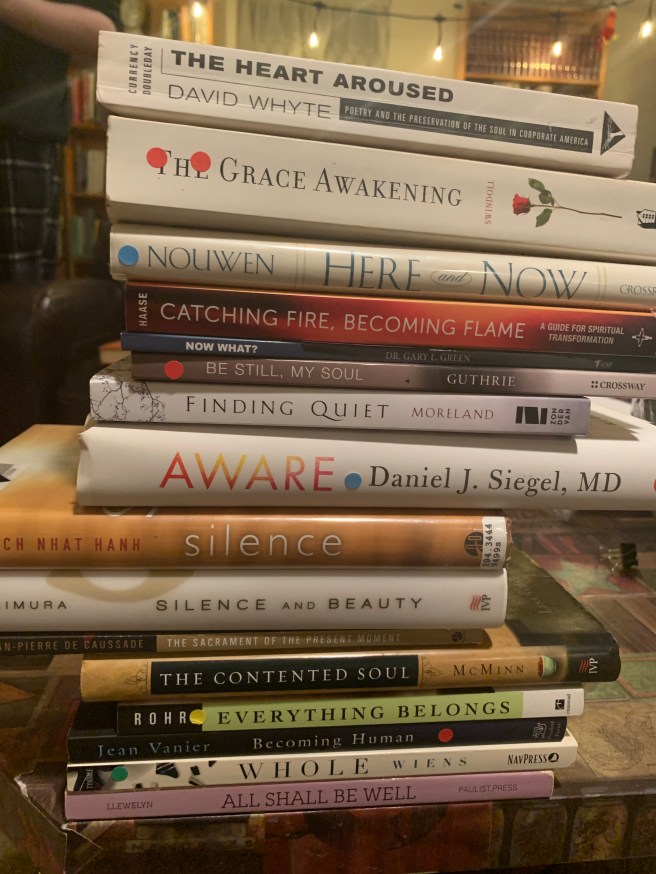
The heart aroused
grace awakening
here and now
catching fire
becoming flame.
Now what?
Be still, my soul.
Finding quiet, aware…
silence
…silence and beauty
the sacrament of the present moment.
Contented soul
everything belongs
becoming human…whole.
All shall be well.

I got bumped yesterday. Emotionally, not physically. In general, I consider myself to operate on a relatively even keel. Steady. Unflappable. But over time, I am coming to realize that as stresses pile up, I feel shaky and uncertain.
Like many people, the uncertainties of COVID-19 has had a significant effect upon me. I have been aware of a simmering anxiety for a couple of weeks now, a whispering shadow that lurks in the cobwebbed corners of my mind. It hasn’t devolved into full blown panic, yet its murmuring is incessant.
Even after nearly 25 years as a trained counselor, I continue to learn new lessons about my emotional life. One of the things that I have more recently discovered is that anger is my prime emotion, what those who are familiar with the Enneagram might call my core passion. But my anger rarely boils over, it simmers. When we were first dating, my wife would often say “Jason got so angry about that.” Not coincidentally, I would get irritated when she said that because I truly did not believe I was an angry person. I didn’t blow up or yell. Twenty-five years together and I’m beginning to understand she was right. I am continuing to work on understanding the complex interplay of my emotions, but one thing is becoming more obvious to me: I am likely to experience a variety of emotions as variants of anger. When I get anxious, it may come out as irritation. When I feel sad, I can feel resentful. Shame leads to self-deprecation.
COVID-19 and all of the changes it has brought in its wake has made me anxious and sad, but I am also discovering that those emotions are spilling out as anger, resentment, or irritation. Two mornings ago, I felt irritated that my son was breathing too loudly and I told him to breathe more quietly. Yesterday, a friend shared a political position that was different than mine and I could feel irritation boiling up within me. It spilled over as I expressed how tired I am of all of the divisiveness. My gut reaction was to view him as guilty, but I quickly recognized those same tendencies within myself, Paul’s words in Romans 2:1 (NIV) flashed through my mind, “You, therefore, have no excuse, you who pass judgment on someone else, for at whatever point you judge another, you are condemning yourself, because you who pass judgment do the same things.”
I long for serenity regardless of circumstance. I want to develop an internal stillness that remains steady even when I am bumped. If my cup runs over, I want it to overflow with the love of Christ and not with anger.
I want to conclude with the text of this prayer from Reinhold Niebuhr, a prayer that was adapted by Alcoholics Anonymous as the “serenity prayer.” My friend Perry, a fellow pilgrim who has been helping me to see the impact of my anger, shared this version yesterday.
God, give me grace to accept with serenity
the things that cannot be changed,
Courage to change the things
which should be changed,
and the Wisdom to distinguish
the one from the other.
Living one day at a time,
Enjoying one moment at a time,
Accepting hardship as a pathway to peace,
Taking, as Jesus did,
This sinful world as it is,
Not as I would have it,
Trusting that You will make all things right,
If I surrender to Your will,
So that I may be reasonably happy in this life,
And supremely happy with You forever in the next.
Amen.

God of hope,
our world seems hopeless.
An unseen enemy assaults us,
emptying our streets,
yet filling us with anxiety.
We have no mooring, no anchor.
We ride white-capped waves
in small vessels
that were never meant
to weather these storms.
Our stockpiles dwindle,
but we cannot see the shore.
We lash ourselves to the mast
and pray we do not capsize.
Our prayers are groans
and tears
and tumbling thoughts.
Many of us hope for the light to break through,
but all we see is darkness.
We don’t even know where to look.
Our darting eyes betray our anxious hearts.
Still our hearts, O Lord,
Still our hearts.

He [Jesus] was supreme in the beginning and—leading the resurrection parade—he is supreme in the end. From beginning to end he’s there, towering far above everything, everyone. So spacious is he, so roomy, that everything of God finds its proper place in him without crowding. Not only that, but all the broken and dislocated pieces of the universe—people and things, animals and atoms—get properly fixed and fit together in vibrant harmonies, all because of his death, his blood that poured down from the cross.-Colossians 1:18-20, The Message
It has taken ten days, but I am finally writing about “reconciliation.” I started by writing about integration on March 16 and then followed up writing about wholeness on March 20. As I indicated, these concepts are important and how I think about life, and, they are in many ways connected, though I do think about them in slightly different terms.
Reconciliation, in my thinking, is closely tied to integration and wholeness, but implies a broader understanding. In the first chapter of Paul’s letter to the Colossians, there is a magnificent description of the “preeminence of Christ” in verses 15 to 20. In the final verse, we discover that in Christ, all things are being reconciled. What are those things? As Eugene Peterson suggested, “people and things, animals and atoms.” Redemption goes beyond the forgiveness of individual sins or restored relationships with people. In reconciliation, God is making all things new.
Yet God does not exclude us from this process. According to 2 Corinthians 5:18 we, as Christ’s ambassadors in the world, have been given “the ministry of reconciliation.” We have been invited to become agents of integration, wholeness, and reconciliation by pointing people to the love of Christ and the hope of reconciliation, which is so much bigger than the forgiveness of sins.
It is no less than God making all things new.


Last year, I had the privilege of co-hosting a conference honoring my friend Dr. Larry Crabb with another friend, Dr. Eric Johnson at Houston Baptist University. Larry is the founder of NewWay Ministries and the author of 26 books. Eric is founder the Society for Christian Psychology and the Gideon Institute for Christian Psychology and Counseling at HBU.
I have shared some of these talks, but given that many of us have extra time on our hands, I have decided to put the links to the talks all in one place.
My conversation with Larry Crabb
If you want to learn more or provide further support for either NewWay Ministries or the Gideon Institute, please consider buying a copy of the book Living in the Larger Story: The Christian Psychology of Larry Crabb. The proceeds are split evenly between these two ministries.
 Jason Kanz